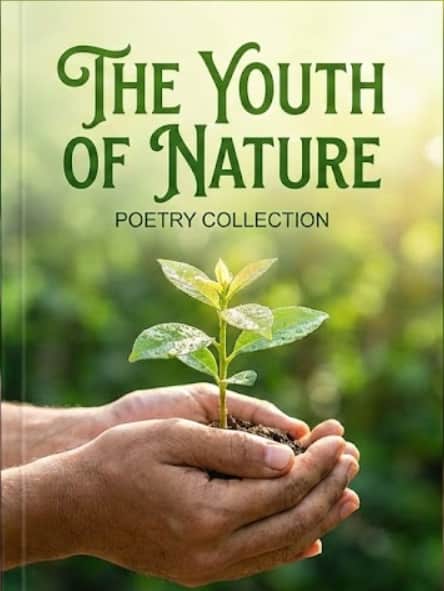
The Youth Of Nature
By Matthew Arnold
Rais’d are the dripping oars
Silent the boat: the lake,
Lovely and soft as a dream,
Swims in the sheen of the moon.
The mountains stand at its head
Clear in the pure June night,
But the valleys are flooded with haze.
Rydal and Fairfield are there;
In the shadow Wordsworth lies dead.
So it is, so it will be for aye.
Nature is fresh as of old,
Is lovely: a mortal is dead.
The spots which recall him survive,
For he lent a new life to these hills.
The Pillar still broods o’er the fields
Which border Ennerdale Lake,
And Egremont sleeps by the sea.
The gleam of The Evening Star
Twinkles on Grasmere no more,
But ruin’d and solemn and grey
The sheepfold of Michael survives,
And far to the south, the heath
Still blows in the Quantock coombs,
By the favourite waters of Ruth.
These survive: yet not without pain,
Pain and dejection to-night,
Can I feel that their Poet is gone.
He grew old in an age he condemn’d.
He look’d on the rushing decay
Of the times which had shelter’d his youth.
Felt the dissolving throes
Of a social order he lov’d.
Outliv’d his brethren, his peers.
And, like the Theban seer,
Died in his enemies’ day.
Cold bubbled the spring of Tilphusa,
Copais lay bright in the moon;
Helicon glass’d in the lake
Its firs, and afar, rose the peaks
Of Parnassus, snowily clear:
Thebes was behind him in flames,
And the clang of arms in his ear,
When his awe-struck captors led
The Theban seer to the spring.
Tiresias drank and died.
Nor did reviving Thebes
See such a prophet again.
Well may we mourn, when the head
Of a sacred poet lies low
In an age which can rear them no more.
The complaining millions of men
Darken in labour and pain;
But he was a priest to us all
Of the wonder and bloom of the world,
Which we saw with his eyes, and were glad.
He is dead, and the fruit-bearing day
Of his race is past on the earth;
And darkness returns to our eyes.
For oh, is it you, is it you,
Moonlight, and shadow, and lake,
And mountains, that fill us with joy,
Or the Poet who sings you so well
Is it you, O Beauty, O Grace,
O Charm, O Romance, that we feel,
Or the voice which reveals what you are?
Are ye, like daylight and sun,
Shar’d and rejoic’d in by all?
Or are ye immers’d in the mass
Of matter, and hard to extract,
Or sunk at the core of the world
Too deep for the most to discern
Like stars in the deep of the sky,
Which arise on the glass of the sage,
But are lost when their watcher is gone.
They are here’ I heard, as men heard
In Mysian Ida the voice
Of the Mighty Mother, or Crete,
The murmur of Nature reply
‘Loveliness, Magic, and Grace,
They are here they are set in the world
They abide and the finest of souls
Has not been thrill’d by them all,
Nor the dullest been dead to them quite.
The poet who sings them may die,
But they are immortal, and live,
For they are the life of the world.
Will ye not learn it, and know,
When ye mourn that a poet is dead,
That the singer was less than his themes,
Life, and Emotion, and I?
‘More than the singer are these.
Weak is the tremor of pain
That thrills in his mournfullest chord
To that which once ran through his soul.
Cold the elation of joy
In his gladdest, airiest song,
To that which of old in his youth
Fill’d him and made him divine.
Hardly his voice at its best
Gives us a sense of the awe,
The vastness, the grandeur, the gloom
Of the unlit gulph of himself.
‘Ye know not yourselves and your bards,
The clearest, the best, who have read
Most in themselves, have beheld
Less than they left unreveal’d.
Ye express not yourselves can ye make
With marble, with colour, with word,
What charm’d you in others re-live?
Can thy pencil, O Artist, restore
The figure, the bloom of thy love,
As she was in her morning of spring?
Canst thou paint the ineffable smile
Of her eyes as they rested on thine?
Can the image of life have the glow,
The motion of life itself
‘Yourselves and your fellows ye know not and me
The Mateless, the One, will ye know?
Will ye scan me, and read me, and tell
Of the thoughts that ferment in my breast,
My longing, my sadness, my joy?
Will ye claim for your great ones the gift
To have render’d the gleam of my skies,
To have echoed the moan of my seas,
Utter’d the voice of my hills?
When your great ones depart, will ye say
All things have suffer’d a loss
Nature is hid in their grave?
‘Race after race, man after man,
Have dream’d that my secret was theirs,
Have thought that I liv’d but for them,
That they were my glory and joy.
They are dust, they are chang’d, they are gone.
I remain.’



 Continue with Google
 Sign in with Facebook