


 Continue with Google
 Sign in with Facebook



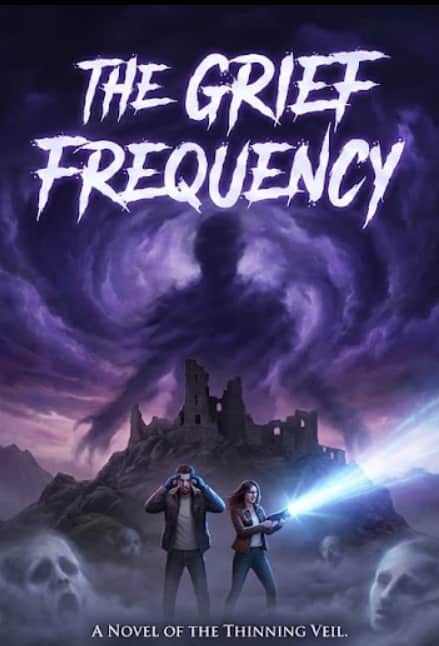
The Grief Frequency
By: San Joes




By: San Joes
The Grief Frequency
Then came the sound.
It wasn’t loud. It was deep. A ultra-low frequency vibration that didn't rattle windows so much as it rattled the marrow in people's bones. It felt like the planet had taken a single, shuddering gasp. Dogs across the metropolitan area threw back their heads and howled in a unified, terrified chorus.
Elias Vance woke up not screaming, but drowning.
He sat bolt upright in his narrow bed, clutching his chest. His heart was hammering against his ribs, but the panic flooding his veins wasn't his. It was cold, sharp, and overwhelming—the raw, icy terror of a man falling from a great height.
Elias looked down at his hands. He wore white cotton gloves to bed, a habit born of necessity. His psychometry—his accursed ability to feel the emotional echoes trapped in objects—had been getting worse for months. He couldn't even brush his teeth without feeling the mild anxiety of the factory worker who’d packaged the tube.
He reached out with a gloved hand to steady himself on his bedside table, an antique oak piece he’d bought cheap. Usually, it just hummed with a dull, woody boredom.
Tonight, as his gloved finger brushed the surface, the table screamed.
A cacophony of voices, decades old, slammed into his mind. A woman sobbing over a telegram in 1942. A child hiding under the bed from a drunken father in 1978. The table had absorbed it all, and now, it was vomiting history into Elias’s brain.
He recoiled, falling out of bed and scrambling backward until his back hit the wall. He pulled his knees to his chest, pressing his gloved hands over his ears.
The tremor faded, leaving behind a silence that felt heavy, thick, and wrong.
Outside his apartment window, in the rain-slicked darkness of the city street below, a streetlamp flickered and died. In the sudden gloom, Elias saw something. A shadow that was too solid, too tall, walking against the wind, trailing tendrils of smoke that didn't dissipate.
He squeezed his eyes shut. "It's just history," he whispered to the empty room, a mantra that had lost its power. "It's just echoes."
But deep down, beneath the layer of his own fear, Elias felt something new ripple through the psychic atmosphere of Port Haven.
Hunger.
Chapter 1: The Bleeding Sword
Three days later, the fog over Port Haven had turned yellow and tasted like copper. The news reports were bizarre and getting worse. A localized flash-freeze in a crowded subway station had left twenty people hospitalized with hypothermia in July.
A riot had broken out at the docks when dozens of longshoremen swore they saw their deceased grandfathers walking out of the sea.
Elias hid in the basement of the Port Haven Historical Society. This was his domain: the archives. The air was climate-controlled, smelling of dust and aged paper. It was usually the quietest place in the city for him, the emotions of the artifacts dulled by time.
Not anymore.
"Elias?"
He jumped, dropping the file folder he was holding. Sarah, the society's cheerful young intern, stood at the end of the aisle, looking concerned.
"You okay? You’ve been down here since Tuesday."
"I'm behind on cataloging," Elias mumbled, adjusting his gloves. He looked terrible. Dark circles bruised the skin under his eyes, and his movements were twitchy.
"There's something weird going on in the Civil War exhibit upstairs," Sarah said. "The director wants you to look at it. Since you're the... object guy."
They knew he had a "sense" for artifacts, though he played it off as extreme intuition born of study. He followed Sarah upstairs to the main gallery.
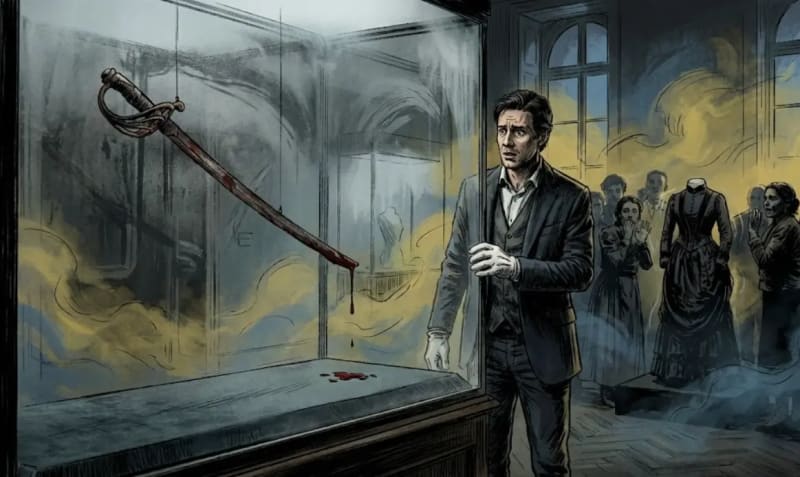
A small crowd had gathered around a glass display case in the center of the room. Inside rested a cavalry saber from 1863. Its steel was pitted, its leather grip rotted.
"Look at the tip," Sarah whispered.
Elias leaned in. A single, thick drop of red liquid formed on the rusted point of the blade. It grew heavy, detached, and fell. But it never hit the velvet lining of the case. It vanished inches before impact.
A moment later, another drop formed.
The air around the case was freezing. Elias’s breath fogged the glass.
"Is it condensation?" someone asked.
Elias knew it wasn't. He squeezed his eyes shut, trying to block out the ambient noise of the room, and focused on the sword. He didn't need to touch it. The emotion rolling off of it was so potent it felt like heat against his skin.
Rage. Absolute, blinding battlefield rage. The smell of black powder and scorched horseflesh. A final, desperate thrust into a gray uniform.
"It's looping," Elias said softly. "It's stuck in the moment of its user's death."
"What?" Sarah asked.
Before he could answer, a sound came from the corner of the room. The Victorian mourning exhibit. A black, heavy silk gown stood on a mannequin behind velvet ropes.
A distinct, choked sob echoed from the dress.
The small crowd gasped and shuffled backward.
Elias stared at the gown. He could feel the suffocating grief radiating from it, a mother who had lost three children to typhoid in a single week. The sorrow was thick enough to choke on.
"Clear the room," Elias said, his voice shaking but firm.
"But Elias—"
"Clear the room, Sarah! Now!"
As the staff shooed the bewildered patrons toward the exit, Elias stood alone in the center of history. The artifacts were waking up. The tremor hadn't just shaken the ground; it had cracked the soundproofing between the past and the present.
And the noise was getting deafening.
Chapter 2: The Dead Zone
Dr. Aris Thorne sat in the dark of her makeshift lab in an abandoned warehouse in the industrial district, watching the oscilloscope screen.
She used to have a real lab at the university. She used to have tenure. Then she'd published her paper, "Harmonic Resonance Theory of Post-Mortem Consciousness." The academic community had laughed her out of town. She was the "Ghost Professor," the brilliant physicist who cracked and started hunting spooks.
They weren't laughing now.
The oscilloscope was going haywire. Aris adjusted the dials on her parabolic microphone array.
"The readings are off the charts, Aris," said Ben, her one remaining grad student, who was huddled in a parka next to a space heater. "The ambient electromagnetic fields in this district are sixty percent higher than last week."
Aris stared at the dancing green line. "It’s not random interference, Ben. Look at the waveform. It’s structured."
She turned up the speakers connected to the mics. The sound that filled the warehouse wasn't static. It was a low, mournful drone, like wind blowing through a cavern. But underneath the drone were whispers. Thousands of them, overlapping, layered so thickly it just sounded like white noise.
"They’re getting louder," Aris murmured.
A police scanner crackled on the desk. “...all units, we have a 10-56 at the tenement on Elm Street. Multiple calls reporting screaming and structural damage. Fire is on scene, they’re saying it’s not smoke, it’s... they don’t know what it is.”
Aris grabbed her coat and her field kit—a duffel bag filled with EMF meters, thermal cameras, and her own prototype acoustic sensors.
"Stay here and monitor the gear," she told Ben. "If that waveform spikes, record it."
"Where are you going? That’s the dead zone."
"Exactly."
Elias was standing outside his apartment building on Elm Street, shivering in the damp night air. Fire trucks were flashing red and blue against the thick fog, but there were no hoses out.
His building had been evacuated. The official reason was a gas leak. Elias knew better.
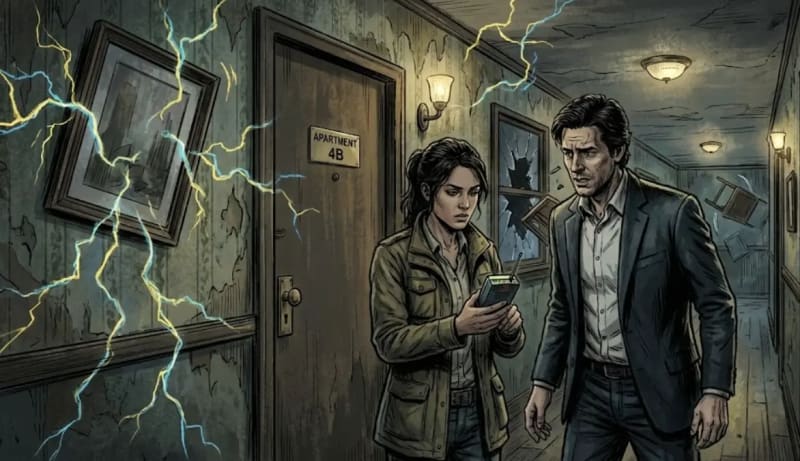
He stood across the street, watching his fourth-floor window. Apartment 4B. Ten years ago, a man named Gary Henson had murdered his wife and daughter there before hanging himself in the shower.
Elias had always felt a cold spot in the hallway near that door. He always hurried past it.
Now, through the rain-streaked window of 4B, Elias saw movement. Furniture was flying. He saw a heavy armchair slam against the glass, cracking it from the inside. The plumbing in the walls was groaning, a metallic shriek that vibrated in his teeth.
He wasn't just seeing it. He was feeling it. Gary Henson’s final hour was replaying in his head. The blind, drunken fury. The sickening regret that came too late. The overwhelming desire to destroy everything he had touched.
Elias pressed his gloved hands to his temples, trying to push Gary out. It was too strong. The barrier was gone.
"Hey."
A woman in a practical, weatherproof jacket stood next to him. She held a strange-looking device with an antenna, pointing it toward the building.
"You're the archivist, aren't you?" she asked. She didn't look at him; her eyes were on the device’s readings.
Elias bristled. "Who are you?"
She finally turned. Her face was sharp, intelligent, and completely lacking the fear that everyone else in the city seemed to wear. "Dr. Aris Thorne. I saw you at the museum once, handling a Neolithic axe like it was radioactive."
Elias shoved his hands into his pockets. "I don't know what you mean."
"Yes, you do. You feel them. The residuals." She nodded toward apartment 4B. "Tell me, what's the primary emotion up there right now? Is it anger? Or is it guilt?"
Elias stared at her. "You're the parapsychologist the university fired."
"That’s me."
Another crash from the apartment building. A window on the third floor blew out, showering the street with glass.
"It’s spreading," Elias whispered, horrified. "Gary is spreading down."
"It’s guilt," Aris said, answering her own question as she adjusted a dial on her device. "Massive, unchecked self-loathing turned outward kinetic energy. Interesting."
"Interesting?" Elias snapped. "People lived in there. My cat is in there."
Aris looked at him, and for a moment, her scientific detachment softened. "The Veil is thinning, Elias. What happened three days ago—that tremor—it fractured the barrier between here and the plane where emotional energy dissipates."
"The Grief Frequency," Elias muttered, remembering a headline from a tabloid he’d seen years ago about her work.
"Exactly. The dead aren't evil. They're confused. They're stuck in loops of their final, strongest emotional states. And right now, they’re all shouting at once, and the volume is breaking our reality."
She stepped closer. "I’m mapping the hot zones. Trying to find the epicenter. My gear can measure the energy, but it can't interpret it. You can."
"No," Elias said, backing away. "I just want it to stop. I want to be left alone."
"It’s not going to stop," Aris said grimly. "Look at the fog, Elias. Really look at it."
Elias looked up at the swirling, yellowish mist above the rooftops. He focused.
The fog wasn't empty. It was thick with faces. Indistinct, gray faces that formed and dissolved in the vapor, mouths open in silent wails. They were drifting over the city like a spectral fallout cloud.
"They're all coming back," Aris said. "And they’re heading for the oldest part of town. If we don't figure out why, this whole city is going to become one giant graveyard."
Elias looked at the faces in the fog, then at his gloved hands. He hated his ability. He hated the constant intrusion of other people’s lives into his own. But the silence he craved was gone forever.
"What do you need me to do?" he asked.
Chapter 3: The Descent
Two weeks later, Port Haven was under martial law. The National Guard patrolled the streets in armored vehicles, but what good were M4 carbines against a sudden, localized drop in temperature that could freeze your corneas? What good were tanks against a pervasive despair that made soldiers sit down on the curb and put their own service weapons in their mouths?
Elias and Aris were in the subterranean tunnels beneath the city's sprawling Cathedral of the Sacred Heart. The city above was modern, but the foundations were ancient. These catacombs dated back to the first settlements.
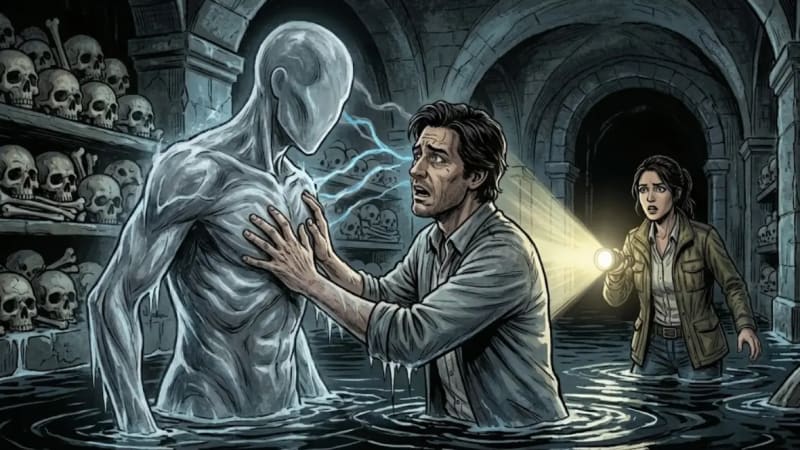
They were waist-deep in freezing, black water. Aris led the way with a high-powered flashlight, the beam cutting through the suffocating darkness. The walls were lined with recessed alcoves, stacked floor-to-ceiling with human skulls and femurs arranged in decorative patterns by long-dead monks.
"Don't look at them," Aris whispered, her breath pluming in the cold air.
"I don't have to look," Elias murmured. His voice was thick, drugged. He’d taken three anti-anxiety pills just to get down here. "I can hear them rattling. They're all whispering the same thing."
"What are they saying?"
"They want to know if it’s morning yet. They’ve been waiting centuries for morning."
Aris stopped. "According to the city survey maps from 1888, there should be a larger chamber ahead. A crypt for the founding families. If my theory is right, the spiritual density there should be high enough to act as a power source."
They needed a "Spirit Well"—a reservoir of concentrated psychic energy—to power the massive resonance device Aris was building in her warehouse. It was a long shot: blast the city with a counter-frequency to stabilize the Veil.
They waded into the crypt. It was a large, circular chamber. In the center sat a stone sarcophagus covered in intricate carvings.
Aris set up her equipment on the lid of the sarcophagus. "Elias, I need you to touch it. I need to know if the energy here is 'clean'—pure mourning, not violent trauma. If it's violent, it could overload the resonator."
Elias approached the stone box. He peeled off his soaking wet right glove. His hand shook.
He placed his palm on the cold stone.
Peace. A deep, heavy, velvet stillness. The quiet resignation of a long life ending in sleep. Sorrow from those left behind, yes, but it was gentle, reverent.
"It's clean," Elias said, his shoulders sagging with relief. "It just feels like... sleep."
Aris nodded. "Good. We can use it. Help me set up the—"
SPLASH.
It wasn't water dripping. It was heavy, wet footfalls in the tunnel behind them.
Aris swung the flashlight beam toward the entrance. Nothing but darkness and rows of skulls.
"Ben?" Aris called out, though she knew her student was miles away.
SPLASH. SPLASH.
Closer now.
From the shadows emerged a figure. It looked human, but it moved with a jerky, puppet-like gait. It was grey, translucent, and radiating a cold so intense that ice crystals bloomed on the water's surface around its shins. It had no face, only a smooth, swirling gray void where features should be.
"A Shade," Aris whispered, horrified. "They aren't supposed to be this solid."
Shades were the bottom feeders of the spirit world—entities that had lost all vestiges of humanity, existing only to feed on warmth and life energy.
The Shade lunged.
It moved with impossible speed. Aris raised her flashlight like a club, but the creature swatted her aside without touching her. A wave of telekinetic force slammed her against the stone wall. She crumbled into the water, dazed.
The Shade turned toward Elias. The cold rolling off it burned his lungs. He could feel its hunger—a vast, empty void that wanted to consume his heat, his memories, his very self.
It grabbed him.
Elias didn't feel hands. He felt two pillars of absolute zero clamp onto his shoulders. The shock was instant. His vision grayed. He couldn't breathe. He could feel his life force being siphoned off like water down a drain.
He was going to die in a basement full of skeletons.
No.
He looked at Aris, struggling to sit up in the freezing water. He remembered what she had told him. They are energy. You interpret energy.
Elias didn't try to pull away. Instead, he did something he had never done in his life. He leaned in.
He tore off his left glove and slammed both bare hands onto the Shade's icy chest.
He didn't just feel it. He connected with it. He opened the floodgates of his mind and let the creature in.
It was like stepping into a blizzard naked. A screaming, arctic emptiness. But beneath the hunger, Elias found something else. A tiny, calcified kernel of memory buried deep within the entity.
A boy freezing to death in a blizzard in 1845. Lost in the woods, crying for his mother until the cold took his voice, then his mind.
Elias latched onto that memory. He didn't fight the cold; he acknowledged it.
I see you, he projected with every ounce of his will. I feel how cold you are. It's okay to be cold.
The Shade froze. The drain on Elias's energy stopped. The faceless grey swirl seemed to pause, confused by empathy where it expected terror.
For a second, the gray fog cleared, and Elias saw the faint, blue-lipped face of a frightened little boy looking back at him.
Then, the entity simply dissipated. It burst into a cloud of harmless vapor that drifted toward the ceiling.
Elias collapsed face-first into the water.
Chapter 4: The Nexus
Aris dragged Elias out of the catacombs. He was catatonic for two days, shivering violently in a cot in Aris's warehouse, mumbling about snow and lost children.
When he finally woke up, the city was worse. The fog was so thick you couldn't see across the street. The air was alive with whispers.
"We have to go to Gallows Hill," Elias said, his voice raspy as he sat up, accepting a mug of hot tea from Aris.
"The old penitentiary site?" Aris said. "Elias, that's the epicenter. The readings there are lethal. It’s suicide."
"That’s where they are all going," Elias said. "All the ghosts in the fog. They’re being pulled there." He looked at her, his eyes haunted but clear. "I saw it when I connected with the Shade. It's not just a tear in the Veil, Aris. Something is pulling it open from the other side. Something huge."
Gallows Hill loomed over the city, a bleak, rocky promontory topped by the blackened ruins of Blackwood Penitentiary. The prison had burned down in 1912 in a riot, taking three hundred inmates and guards with it. It was the darkest stain on the city's history.
Now, it was a vortex. Above the hill, the clouds swirled in a permanent, bruising purple storm. Lightning flashed silently, illuminating the broken stone towers.
Aris and Elias drove as close as they could in Aris’s reinforced van, the resonator device loaded in the back. They had to finish the journey on foot, carrying the heavy equipment up the winding path to the ruins.
The air on the hill was vibrating. The ground was slick with psychic residue—ectoplasm that looked like oil and smelled like ozone.
They breached the rusted iron gates of the outer wall. The courtyard was a nightmare. Spectral figures hung from invisible nooses from the high walls, jerking in silent spasms. The ground shifted under their feet, turning from dirt to ash and back again.
"Stick close to me," Aris yelled over the wind, holding an EMF meter that was pegged at maximum. "The reality matrix here is unstable. The building remembers the fire."
They entered the main cell block. It was like walking into a blast furnace of hate. The iron catwalks above them groaned. Spectral fires flickered in the empty cells, replaying the final moments of trapped men burning alive.
Elias walked with his eyes closed, letting Aris guide him. If he looked, the sensory input would shatter his mind. He felt the walls.
Pain. Brutality. The crushing weight of institutional cruelty. A guard beating a prisoner to death with a baton. A prisoner stabbing another over a piece of bread.
"The Rotunda," Elias choked out. "The center. We have to go to the center."
They reached the central guard tower, a vast circular space where the cell blocks converged.
And there it was.
In the center of the rotunda, hovering ten feet off the ground, was a tear in the air. It looked like a bleeding wound in reality, jagged edges shimmering with violet light.
But it wasn't just a hole. Something was coming through it.
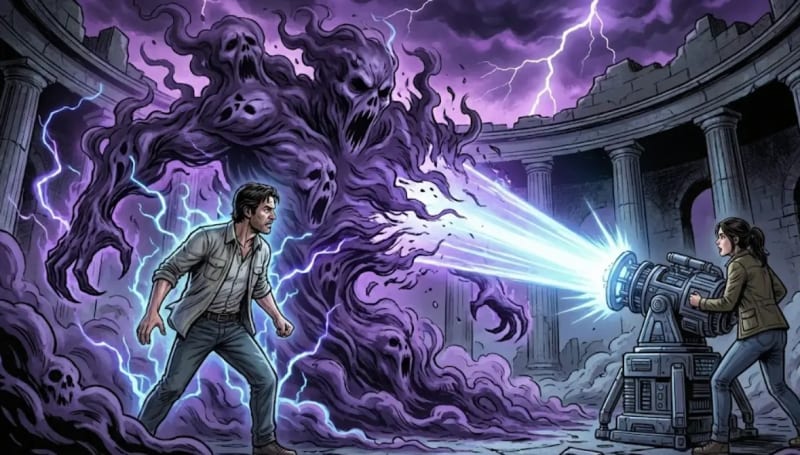
A massive, shifting entity made of shadow and smoke billowed out of the rift. It filled the vast space, towering over them. It had no defined shape, but faces boiled to its surface and were reabsorbed—hundreds, thousands of them. The faces from the fog. The faces of Port Haven’s dead.
This wasn't a ghost. This was The Collective. An amalgam of centuries of pain, rage, and sorrow, grown so massive it had achieved a terrible kind of sentience. It had broken through to feed on the rich, terrified life of the city.
It didn't attack physically. It attacked with its mind.
A wave of psychic force slammed into them. Aris dropped to her knees, screaming, clutching her head.
Elias was blown backward. He hit the stone floor, and the world dissolved.
He wasn't on Gallows Hill anymore. He was drowning in the harbor in 1888, water filling his lungs. No, he was burning in the 1912 fire, his skin blistering. No, he was Gary Henson, putting the rope around his neck.
He was feeling ten thousand deaths simultaneously. His identity was being ground into dust.
GIVE IN.
The voice roared in his head—a chorus of the damned.
BECOME PART OF THE SONG. THERE IS NO PAIN WHEN YOU ARE EVERYTHING.
It would be so easy. To just let go. To stop being Elias Vance, the terrified archivist, and become a drop in this dark ocean.
Through the psychic maelstrom, he felt a sensation. A hand grabbing his ankle.
Warmth.
It was a singular, impossible sensation in this hurricane of death. He focused on it. He traced the warmth back.
Aris. She was on the floor, bleeding from her nose, but her eyes were open, locked onto his.
"Elias!" Her voice sounded like it was coming from the bottom of a well. "You are not them! Anchor yourself!"
Anchor. Yes. He was Elias Vance. He hated loud noises. He liked his tea lukewarm. He was afraid of history.
He grabbed onto his own fear. It was his. It proved he was alive.
He pushed back against the tide. He sat up, gasping for air. The hallucinations receded, leaving him back in the ruined rotunda, staring up at the towering shadow monster.
"The device, Aris!" he yelled. "Set it up!"
Aris scrambled to the resonator cases.
Elias stood up. He pulled off his gloves and threw them on the ash-covered floor.
He walked toward The Collective. The cold was intense enough to crack stone, but he didn't stop. He walked until he stood directly beneath the swirling mass of souls.
He raised his bare hands.
"Alright," he whispered to the monster. "You want me to feel it? Let's feel it."
He didn't just touch the entity. He embraced it. He thrust his psychic awareness deep into the heart of the storm.
He was instantly engulfed in an ocean of agony. But this time, he didn't try to block it. He opened himself up to it completely.
He felt the terror of the drowned sailor. He felt the rage of the murdered prisoner. He felt the endless, aching sorrow of the grieving mother.
And then, he did the only thing he could do. He projected something back.
Not fear. Not anger.
Acceptance.
I see you, he thought, broadcasting the thought with blinding intensity. I feel your pain. It was real. You mattered.
He validated the suffering of thousands of souls who had died alone and unheard. He offered them the one thing they had never had: a witness.
The Collective shrieked—a sound that cracked the remaining glass in the rotunda windows. The swirling shadows shuddered. The entity paused, paralyzed by this alien sensation of empathy.
"NOW, ARIS!" Elias roared, blood trickling from his nose.
Aris threw the master switch on the resonator.
The machine screamed to life. A tone so deep it wasn't heard, but felt, blasted through the rotunda. It was a counter-frequency, designed to disrupt the psychic cohesion of the spectral energy.
The sound wave slammed into The Collective. The entity seemed to vibrate. The swirling faces elongated, stretching like taffy.
Elias held on, pouring empathy into the cracking structure of the beast while the sound waves battered it from the outside.
The Collective began to unravel. The shadow turned to gray mist. The violet tear in the air wavered, shrinking.
The entity didn't explode. It dissolved. It was like watching ink rinse out of a brush in water. The thousands of trapped souls within it were released, not violently, but with a collective sigh of relief. They faded, rising like steam, finally free to move on to whatever lay beyond.
The tear snapped shut with a sound like a thunderclap. The purple storm above the hill vanished instantly, revealing a clear, star-filled night sky. Elias collapsed onto the cold stone floor and knew nothing more.
Epilogue: The Silent Morning
The morning sun burned off the last of the fog over Port Haven. The air was clear for the first time in months. The temperature was a balmy sixty-five degrees.
Elias stood on the balcony of a new apartment in a modern glass-and-steel high-rise. Aris had insisted he move out of the old building. "Neutral ground," she’d called it.
The city was recovering. The National Guard had pulled out. The ghosts were gone—mostly.
The world hadn't gone back to normal. The Veil was patched, but Aris’s data showed it was thinner now. Permanently. Ghosts were now a scientifically proven fact. Congress was debating "Spectral Rights."
Aris was famous. She hated it, but she was currently on a televised panel discussion about the ethics of communicating with the deceased.
Elias leaned his hands on the balcony railing. He wasn't wearing gloves.
He felt the metal of the railing. He felt the echo of the construction worker who had bolted it into place three years ago. The man had been worried about his daughter’s tuition payments, but proud of his sturdy work.
Elias smiled faintly. It was just a whisper now. Manageable.
He turned to go back inside. As he stepped into his living room, the air near his bookshelf shimmered.
A faint, translucent figure of an elderly man in a 1950s suit appeared. He looked confused, adjusting a spectral tie.
Elias didn't jump. His heart didn't race. He just sighed, walked over to his armchair, and sat down.
"Okay," Elias said calmly to the ghost. "You're confused. You missed your exit. Tell me what you need to say so you can move on. I'm listening."
if you liked this book, take a moment to share this to our community and help other to reach this book. Thank you by LeafyReads❤️